
Introduction
You got the raise. Five thousand dollars more per year — a real win. Twelve months later, your bank balance looks exactly the same. Where did it go? It went to the nicer apartment, the new car payment, the upgraded phone, the subscriptions you “deserved.” Welcome to lifestyle inflation: the silent killer of every pay raise you’ve ever gotten.
Table of Contents
- – What Lifestyle Inflation Actually Is
- – The Hedonic Treadmill: Why More Never Feels Like Enough
- – The Real Math of a Vanished Raise
- – Warning Signs You’re Infected
- – The Playbook: Beat Lifestyle Inflation for Good
What Lifestyle Inflation Actually Is
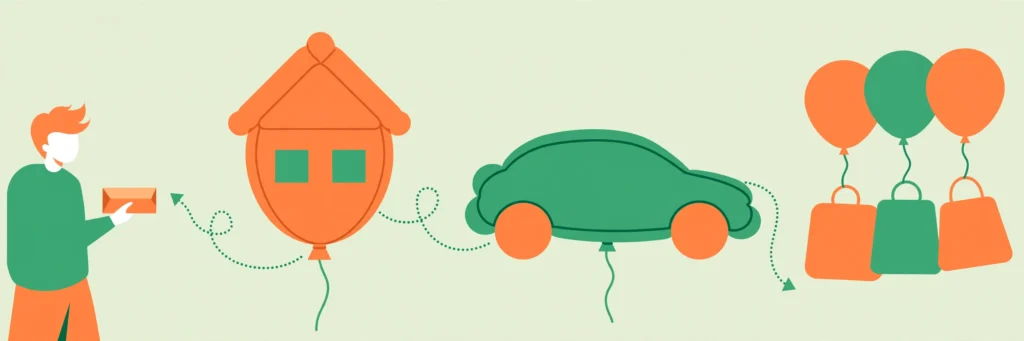
Lifestyle inflation is simple: as your income goes up, your spending goes up by the same amount — or more. You don’t notice it happening because it doesn’t feel like spending more. Each upgrade feels earned, normal, even modest. A slightly nicer apartment here, eating out a bit more there, a car that’s “only” $80 more a month.
The cruel part is that it’s nearly invisible while it’s happening. Nobody blows a raise on one ridiculous purchase. They leak it across a dozen small upgrades, each one justified on its own. Together, they eat the entire raise — and sometimes your savings too.
The Hedonic Treadmill: Why More Never Feels Like Enough
Psychologists have a name for this: the hedonic treadmill. Humans adapt to better circumstances shockingly fast. The nicer car feels exciting for about a month, then it just becomes your car. The bigger apartment is thrilling until it’s simply where you live. Then your brain resets, looks around, and starts wanting the next thing.
This is why lifestyle inflation is so hard to beat with willpower alone. It’s not a character flaw — it’s wiring. Every upgrade delivers a quick hit of happiness that fades, and the wanting starts over. The treadmill only stops when you decide, deliberately, that enough is enough. Not in theory — with an actual number attached.
The wealthy people who stay wealthy aren’t the ones who earn the most. They’re the ones who stepped off the treadmill early and stayed off.
The Real Math of a Vanished Raise
Let’s do the honest arithmetic. Say you get a $5,000 raise:
- – Scenario A — the typical outcome: You absorb $5,000 in new spending. Apartment upgrade, car payment bump, nicer groceries. Wealth created: $0. You work just as hard for the same net worth.
- – Scenario B — the smart outcome: You save $2,500 and spend $2,500. You still enjoy half the raise — the upgrade feels real — but your wealth grows by $2,500 every year. Over 10 years with modest growth, that’s roughly $30,000+ in real money from one raise.
- – Scenario C — the trap: You spend $7,000 on a $5,000 raise (the new car needed a loan, the apartment was $400 more per month). Wealth created: negative $2,000 per year. You are literally poorer with a higher salary.
Most people live in Scenario A. A shocking number live in Scenario C. The difference between A and B isn’t earning more — it’s deciding, before the money arrives, where it goes.
Warning Signs You’re Infected
Run through this checklist honestly:
- Your savings rate hasn’t moved in years. Income up, savings flat — that’s lifestyle inflation, by definition.
- You “need” upgrades to things that worked fine a year ago. The phone, the car, the couch — all suddenly inadequate.
- A raise came and your checking account looks identical. The money arrived; it just never stayed.
- You use the word “deserve.” “I deserve this” is lifestyle inflation’s favorite sentence.
- Your fixed costs keep creeping. Rent, car payment, subscriptions — the monthly baseline rises every year and never comes back down.
- You’d be scared if your income dropped 20%. If a pay cut back to last year’s salary sounds like a crisis, your lifestyle has outrun your actual needs.
If three or more of these hit home, you’re infected. The good news: it’s completely curable.
The Playbook: Beat Lifestyle Inflation for Good
- 1. Save half of every raise automatically. Before the raise hits your paycheck, increase your automatic savings or investment contribution by half the raise amount. You never see the money, so you never miss it. A $5,000 raise becomes $2,500 in savings and $2,500 in your pocket — and your life still got better.
- 2. Automate the skim before it hits checking. This is the single most powerful tactic. Set up automatic transfers that pull your target savings out of your account on payday — before you can spend it. What you don’t see, you don’t spend. Manual saving fails; automatic saving works.
- 3. Use the 24-hour rule for upgrades. Any lifestyle upgrade over $100 waits 24 hours. A new gadget, a nicer subscription tier, the premium version of something — sleep on it. Most urges die overnight. The ones that survive are usually worth it.
- 4. Audit your recurring “upgrades.” Once a year, list every subscription and recurring bill. Circle every one that’s an upgrade from what you had two years ago — streaming tiers, meal kits, premium apps, the bigger data plan. Cancel or downgrade anything you wouldn’t miss. Recurring charges are lifestyle inflation’s favorite hiding spot because you feel them only once, then forget them forever.
- 5. Set an “enough” lifestyle budget. Pick an actual monthly spending number that covers a good life — not a deprived one, a good one. Write it down. Every raise after that goes to savings and investments, not to raising the number. This is the single decision that steps you off the hedonic treadmill. “Enough” is a number, not a feeling.
- 6. Cap the big three. Housing, transportation, and food are where raises go to die. Keep housing under 30% of income, buy a car you can afford on your old salary (not the new one), and watch restaurant spending when income rises. If these three stay flat while your pay grows, you’ve already won.
The Bottom Line
Lifestyle inflation isn’t about never enjoying your money — it’s about enjoying it on purpose. Save half of every raise, automate before you see it, and decide what “enough” looks like with a real number. Do that consistently and every raise builds wealth instead of vanishing. The treadmill stops the moment you decide it does.