Introduction
Nobody plans to stop paying their credit cards. It usually starts with a missed payment during a rough month — a job loss, a medical bill, a car repair — and then the “I’ll catch up next month” that never comes. If that’s where you are, here are straight facts, not shame: exactly what happens if you don’t pay credit card debt, stage by stage, plus legitimate ways out.
Table of Contents
- – The Timeline: 30 Days to 7 Years
- – Fees, Interest, and the Snowball Nobody Wants
- – What Collectors Can and Can’t Do to You
- – When Creditors Sue (and What That Really Means)
- – Better Ways Out Than Walking Away
The Timeline: 30 Days to 7 Years
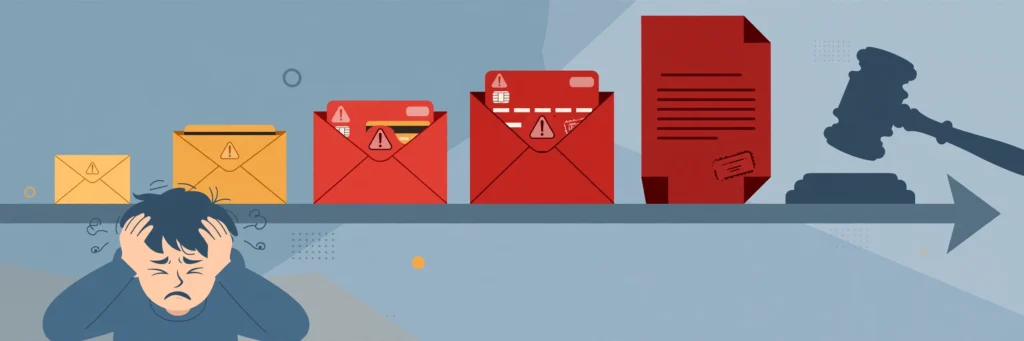
- Day 30 late. Your creditor reports the late payment to the credit bureaus. A single 30-day late mark can drop your score 60 to 100+ points. Late fees kick in (up to around $30–$41 depending on your card agreement).
- 60 days late. Another mark hits your report. Your card issuer may slash your credit limit or raise your interest rate to a penalty APR, often near 30%.
- 90 days late. Now it’s serious. Most issuers will close or freeze the account. Calls and letters intensify. Your score is deep in the hole.
- 120–180 days late. At around 180 days, the creditor typically “charges off” the account — an accounting move meaning they’ve given up on collecting it themselves. Charge-offs stay on your credit report for up to 7 years from the date of first delinquency.
- After charge-off. The debt is usually sold to a collection agency for pennies on the dollar, and the collectors start calling. This is also when lawsuits become possible.
- 7 years. Late payments, charge-offs, and collection accounts age off your credit report — seven years from the original delinquency date, not from when a collector bought the debt.
Fees, Interest, and the Snowball Nobody Wants
Here’s what surprises most people about what happens if you don’t pay credit card debt: the balance doesn’t sit still. Interest keeps compounding on the unpaid balance, late fees stack up, and a $5,000 balance at penalty APR can balloon alarmingly in a year of non-payment. Walking away doesn’t freeze the debt — it lets it grow while your credit burns. This is exactly why killing debt while prices keep rising matters even more during inflationary periods — here’s how to kill debt when inflation is still hot.
What Collectors Can and Can’t Do to You
The Fair Debt Collection Practices Act (FDCPA) sets real limits on third-party collectors:
- They CAN: call you (within reasonable hours), send letters, report the debt to credit bureaus, and sue you after proper notice.
- They CAN’T: call before 8 AM or after 9 PM, harass or threaten you, lie about the amount you owe, discuss your debt with your employer or neighbors, or continue contacting you after you’ve sent a written cease-and-desist (though they can still sue).
Collectors count on you not knowing your rights.
When Creditors Sue (and What That Really Means)
Collectors and original creditors CAN sue for unpaid credit card debt, and if you ignore the lawsuit, they win by default — that’s how most cases go. A judgment can lead to:
- – Wage garnishment — but the rules vary by state. Some states, like Texas and Pennsylvania, heavily restrict or prohibit wage garnishment for credit card debt. Federal law caps garnishment at 25% of disposable earnings in states that allow it.
- – Bank account levies — a creditor with a judgment can sometimes freeze and seize funds from your bank account.
- – Property liens — in some states, judgments can attach to real estate.
The key word is “can.” Lawsuits cost creditors money too, which is why smaller debts are less commonly sued over — but it happens. Never ignore court papers. Showing up, even to negotiate, beats a default judgment every time.
Better Ways Out Than Walking Away
Stopping payment is the most expensive way to handle debt. Before you go there, consider these legitimate routes:
- – Hardship programs. Call your issuer and ask. Many have internal programs that temporarily lower your rate, waive fees, or set up a fixed payment plan. They’d rather get paid slowly than sell your debt for 10 cents on the dollar.
- – Nonprofit credit counseling. Agencies affiliated with the NFCC (National Foundation for Credit Counseling) offer free or low-cost counseling and can set up a Debt Management Plan — one monthly payment, reduced rates, typically 3–5 years to debt-free.
- – Debt snowball or avalanche. If you can still make minimums, pick a payoff method and attack. The debt snowball vs avalanche debate has a clear answer depending on your personality — read which method actually gets you debt-free faster and start this month.
- – Settlement. As a last resort, creditors sometimes accept a lump sum for less than the full balance. Get any agreement in writing before paying a dime.
The honest bottom line on what happens if you don’t pay credit card debt: 7 years of credit damage, growing balances, collector calls, and possible lawsuits — all while legitimate alternatives exist that cost you far less. If you’re drowning, call an NFCC counselor this week. It’s free, it’s non-judgmental, and it’s the first step that actually moves you forward.
Try It Free: The MoneyMatrixs Budget Tool
Reading is step one — doing is step two. Our free budgeting tool takes about 2 minutes: enter your income and expenses, see exactly what’s left over, and track your savings goal. No signup needed — your numbers stay private in your own browser.
Stop Reading. Start Doing.
Knowledge without action is just entertainment. The Budget Planner 2026 is a 21-page printable workbook — monthly budget sheets, debt payoff planner, savings trackers, the 52-week money challenge and more. $12, instant download, yours forever. Your future self will thank you. Use code LAUNCH20 at checkout for 20% off — launch sale ends October 19, 2026.