Introduction
Budgeting advice usually fails at the same point: it tells you to “track every penny” and then leaves you drowning in spreadsheets by week two. The 50/30/20 budget rule takes the opposite approach — three buckets, one simple split, no line-item accounting required. Here’s the 50/30/20 budget rule explained simply, with real numbers for a $4,000 monthly take-home paycheck, plus the honest adjustments for when your rent alone eats half your income (because in 2026, it often does).
Table of Contents
- – The 50/30/20 Budget Rule in 30 Seconds
- – A Real Example: $4,000 Take-Home Pay
- – When 50/30/20 Doesn’t Fit (and How to Fix It)
- – The Mistake That Breaks Every 50/30/20 Budget
- – 50/30/20 Budget Rule vs. Zero-Based Budgeting: Which Wins?
The 50/30/20 Budget Rule in 30 Seconds
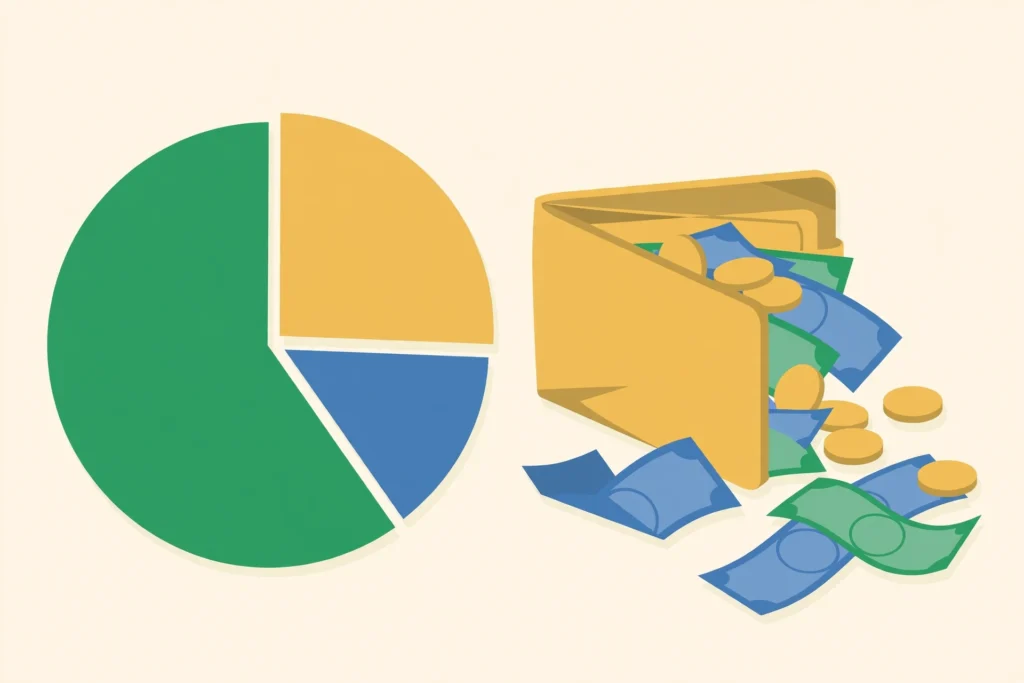
Split your after-tax income into three buckets:
- – 50% — Needs: housing, utilities, groceries, insurance, minimum debt payments, transportation, childcare. The non-negotiables.
- – 30% — Wants: dining out, streaming, hobbies, travel, the fun stuff. Yes, fun gets its own funded bucket — that’s the point.
- – 20% — Savings and extra debt payoff: emergency fund, retirement contributions, investments, and anything beyond minimum debt payments.
That’s it. No categories within categories, no guilt spreadsheet. If your spending roughly matches those percentages, your budget works.
A Real Example: $4,000 Take-Home Pay
Let’s make it concrete. You bring home $4,000 a month after taxes:
- – Needs: $2,000. Say $1,400 rent, $150 utilities, $350 groceries, $100 car insurance. That’s $2,000 exactly — tight but workable.
- – Wants: $1,200. $400 dining out and takeout, $200 entertainment and subscriptions, $300 shopping and hobbies, $300 travel savings. This is guilt-free money — the rule’s genius is that it permits spending instead of demanding monk-like discipline.
- – Savings: $800. $400 to the emergency fund, $400 to a Roth IRA or 401(k). In one year, that’s $9,600 saved — without ever opening a budgeting app.
The key discipline is small: once a bucket is empty, it’s empty. Overspend on wants in week two? You’re cooking at home for the rest of the month. The buckets do the enforcing so willpower doesn’t have to.
When 50/30/20 Doesn’t Fit (and How to Fix It)
In high-cost cities, housing alone can devour 50% — leaving nothing for other needs. That’s not a personal failure; it’s math. Three legitimate fixes:
- Flip to 60/20/20: 60% needs, 20% wants, 20% savings. Protect the savings bucket at all costs — it’s the one that builds your future.
- Go 70/20/10 temporarily: If you’re aggressively killing debt or building a starter emergency fund, 10% savings for six months beats 0% forever. If money is genuinely tight overall, these budget tactics that work on a low income pair well with the percentage approach.
- Attack the needs side: The biggest lever is almost always housing or transportation. A roommate, a refinance, or a cheaper car moves the percentages more than a hundred small cuts to wants ever will.
The Mistake That Breaks Every 50/30/20 Budget
Miscategorizing wants as needs. The $80 “grocery” run that’s really snacks and wine? Wants. The premium phone plan when a $25 one would do? Wants. The rule only works if you’re ruthless about the boundary — needs are what keeps a roof over your head and the lights on. Everything else is a want wearing a costume. Be honest for one month and the percentages will tell you the truth about your money.
50/30/20 Budget Rule vs. Zero-Based Budgeting: Which Wins?
If the 50/30/20 budget rule feels too loose, its stricter cousin is zero-based budgeting, where every dollar gets a job until income minus expenses equals zero. Zero-based wins on precision; 50/30/20 wins on sustainability. Beginners should start with 50/30/20 — you can always graduate to the detailed version once the habit sticks. The best budgeting method is the one you’ll still be using in six months.
Try It Free: The MoneyMatrixs Budget Tool
Reading is step one — doing is step two. Our free budgeting tool takes about 2 minutes: enter your income and expenses, see exactly what’s left over, and track your savings goal. No signup needed — your numbers stay private in your own browser.
Stop Reading. Start Doing.
Knowledge without action is just entertainment. The Budget Planner 2026 is a 21-page printable workbook — monthly budget sheets, debt payoff planner, savings trackers, the 52-week money challenge and more. $12, instant download, yours forever. Your future self will thank you. Use code LAUNCH20 at checkout for 20% off — launch sale ends October 19, 2026.